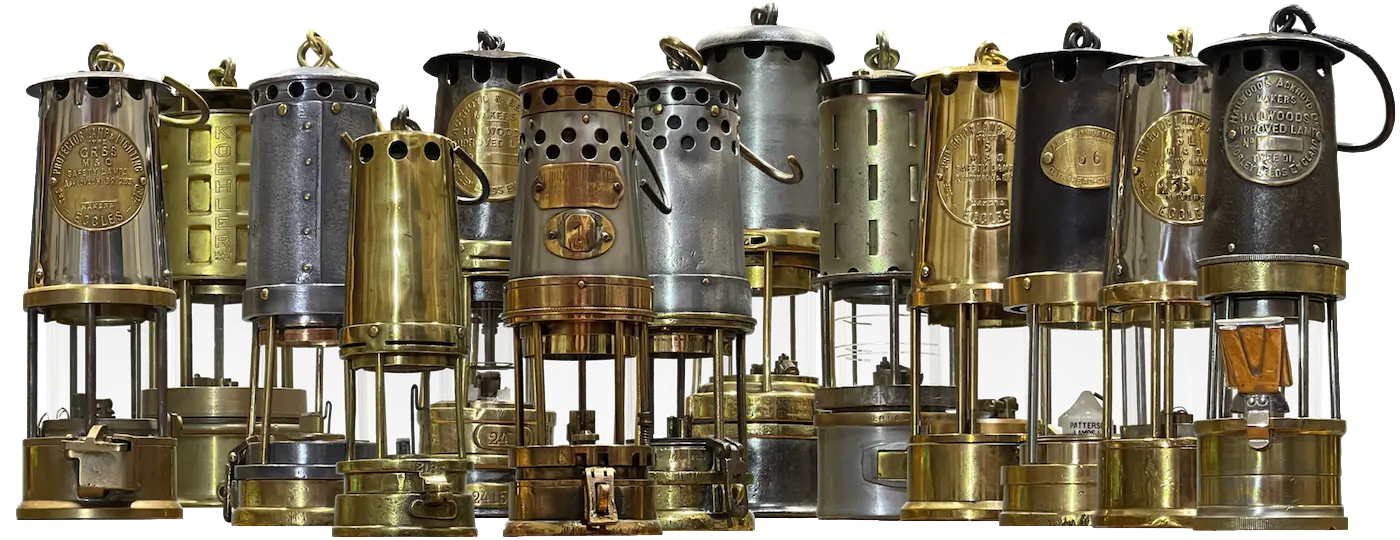
Flame safety lamps
A flame burns inside glass and wire gauze. The gauze cools the flame so it can’t ignite the firedamp outside, and the flame itself shows when gas is present. Davy, Stephenson and Clanny all brought out lamps between 1813 and 1815.
Representative recreation of a Davy-type safety lamp. Recreation based on “Davy-lamp-0462” by PereslavlFoto, CC BY-SA 3.0, and Plate 5 of Philosophical Transactions vol. 107 (1817), public domain, via Wikimedia Commons. Shared under the same licence.Davy
Gauze all round, no glass. Safe but dim, so later Davys were mostly used for testing gas.
- From 1815–16
- Look for: a tall gauze, a brass ring and vessel
- Makers: John Mills, Davis of Derby, E. Thomas & Williams
Clanny
Glass below, gauze above, so more light. Plain Clannys are generally from before the 1911 Coal Mines Act in Britain.
- Dr William Reid Clanny, first lamp 1813
- Makers: John Mills, J.H. Naylor
An early J.H. Naylor Clanny →Mueseler
A Clanny outside with a metal chimney inside the gauze to draw air through. Belgium’s compulsory lamp from 1864.
- Mathieu Mueseler, Liège, 1840
- Look for: a chimney when you look down through the gauze
- British example: the Patterson B7
Henry McCartney’s Patterson B7 →Marsaut and bonneted lamps
Two or three gauzes under a metal bonnet that shields the flame from fast air. The ancestor of most 20th-century lamps.
- Jean-Baptiste Marsaut, Bessèges, 1880s
- Look for: a solid bonnet with air holes
- Makers: Protector, Wolf, Naylor, Patterson, Friemann & Wolf
The Protector MC40 →Benzine lamps
German and Central European lamps burning benzine (white spirit), usually with a built-in relighter and a magnetic lock.
- From the 1880s
- Makers: Friemann & Wolf, Seippel, Koehler, Elektrometal
Impact ignition in safety lamps → Carbide lamps
Representative recreation of a brass carbide cap lamp. Recreation based on “Carbide lamp lit” by Scott Ehardt, public domain, via Wikimedia Commons.Carbide cap lamps
Water drips onto calcium carbide and makes acetylene, which burns in front of a reflector. Bright, cheap and open-flame, so for metal mines, not gassy coal.
- From about 1900
- Makers: Justrite, Auto-Lite, Guy’s Dropper, Premier
- Check the burner, reflector and felt for originality
Lamp of the Day: the Demon Strike Light →Carbide hand lamps
Bigger acetylene lamps for the hand or to hang on the wall, often brass, steel or cast aluminium, with a hook and a wide reflector.
- Used in tunnels, fortifications and caves as well as mines
- French lamps are often stamped “Breveté S.G.D.G.”
Lamp of the Day: the Copper Queen → Open flame
Representative recreation of an 18th-century frog lamp. Recreation based on “Froschlampe 18. Jahrhundert (3)” by 1971markus, CC BY-SA 4.0, via Wikimedia Commons. Shared under the same licence.Frog lamps and open lights
Before and alongside safety lamps, miners worked by candle and by open oil lamps: candleholders with a spike (“sticking tommies”), oil-wick cap lamps and the open “frog” lamps of Europe.
- Mount Kembla in 1902 showed what naked lights could do in a gassy mine
- Frog lamps are among the most faked lamps of all
Fake miners’ lamps: what to check → Electric lamps
Representative recreation of an electric miners’ hand lamp. Recreation based on “Lampe électrique ogivale” by Jmh2o, CC BY-SA 4.0, and “Petlamp” by Thiagominete, CC BY-SA 4.0, via Wikimedia Commons. Shared under the same licence.Electric hand and cap lamps
Electric hand lamps and cap lamps with a battery on the belt took over from the 1910s and 1920s. A German CEAG electric hand lamp won Britain’s 1911 £1,000 lamp prize.
- Makers: CEAG, Oldham, Edison (MSA), Wolf, SEMOI
- Old batteries can still hold acid or alkali
Electric cap lamps → A short timeline
- 1730s onwardThe Spedding steel mill: a spinning steel wheel against flint gives a shower of sparks to work by in gassy places.
- 1812The Felling explosion near Gateshead kills 92 and spurs the search for a safe lamp.
- 1813–1815Clanny, Stephenson and Davy produce the first safety lamps.
- 1840Mueseler’s chimney lamp, Liège.
- 1880sMarsaut’s bonneted multi-gauze lamp.
- About 1900Carbide lamps arrive in metal mines.
- 1911Britain’s Coal Mines Act sets stricter standards for approved safety lamps.
- 1910s–1930sElectric cap lamps take over for lighting; flame lamps stay on for gas testing.
Identify your lamp All flame safety lamp posts

 Collecting, preserving and sharing the history of miners’ lamps